Yarn Cone Labels Explained: A Guide to Fibre Types and Abbreviations
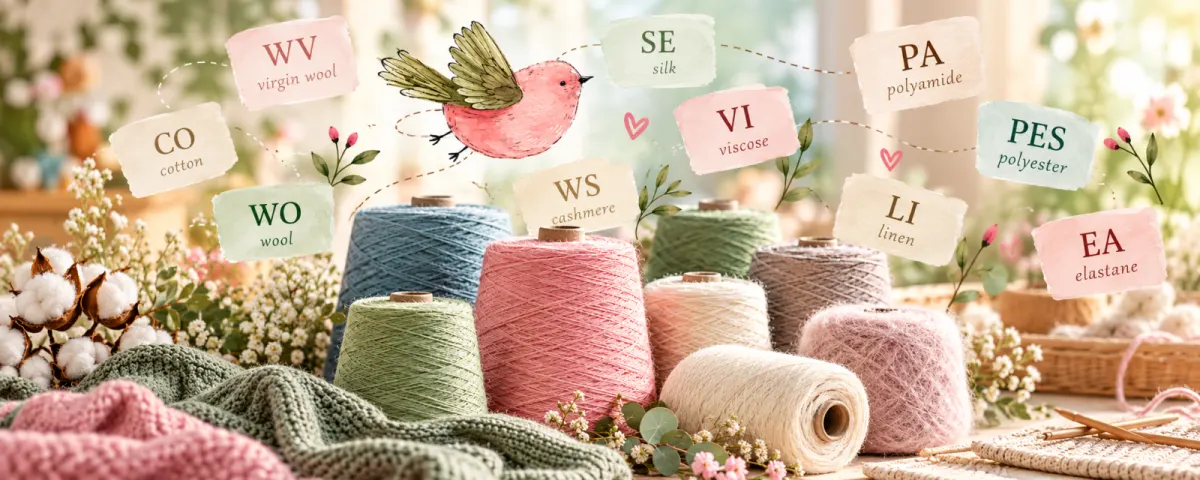
When buying yarn on cones for machine knitting or hand knitting, you may come across short codes such as SE, WV, PA, VI or PES on the label. These abbreviations describe the fibres used to make the yarn, but their meanings are not always obvious.
Understanding yarn composition helps you choose the right material for your project, understand how the knitted fabric may feel and behave, and make more informed purchasing decisions.
In this guide, you will learn what common yarn fibre abbreviations mean, how to read composition labels and what to consider when choosing yarn for your next knitting project.
1. Natural Animal Fibres
Animal fibres are valued for their warmth, softness, elasticity and distinctive textures. Their properties vary depending on fibre quality, yarn construction and finishing.
WV — Virgin wool
Virgin wool is new wool that has not previously been processed into a textile product. It is often used in knitting yarns because of its natural elasticity, warmth and versatility.
WO — Wool
WO stands for wool, usually sheep's wool. Wool can be used for a wide range of knitted garments, accessories and home textiles.
SE — Silk
SE stands for silk, a natural protein fibre produced by silkworms. Silk is known for its smooth texture, subtle lustre and beautiful drape. It is often blended with wool, viscose or other fibres to create elegant knitted fabrics.
WP — Alpaca
WP stands for alpaca fibre. Alpaca is appreciated for its softness, warmth and lightweight feel.
WS — Cashmere
WS stands for cashmere, a fine undercoat fibre obtained from cashmere goats. It is valued for its softness, warmth and luxurious feel.
WM — Mohair
WM stands for mohair, a fibre obtained from Angora goats. Mohair often creates a soft, fluffy halo and adds texture to knitted fabric.
WA — Angora
WA generally refers to Angora rabbit fibre in standard textile labelling. It is known for its lightness and softness.
WY — Yak
WY stands for yak fibre, which is valued for its warmth and natural softness.
WK — Camel
WK indicates camel hair, a natural animal fibre used in selected yarns and textile blends.
WL — Llama
WL stands for llama fibre, which can be used in warm and textured yarns.
WG — Vicuña
WG indicates vicuña fibre, a particularly fine and valuable animal fibre.
WU — Guanaco
WU stands for guanaco fibre, another fine animal fibre used in specialised textiles.
What is the difference between WO and WV?
Both abbreviations relate to wool, but they do not mean exactly the same thing. WO stands for wool, while WV specifically indicates virgin wool. Virgin wool has not previously been processed into a textile product. The abbreviation does not automatically guarantee a particular level of softness, thickness or overall quality.
2. Natural Plant Fibres
Plant fibres are often chosen for their breathability, natural texture and suitability for lightweight garments and accessories.
CO — Cotton
CO stands for cotton, a natural fibre obtained from the cotton plant. Cotton yarn is commonly used for summer garments, children's clothing and home textiles.
LI — Linen
LI stands for linen, a fibre obtained from flax. Linen yarn can create breathable fabrics with a distinctive natural texture. It generally has less elasticity than wool, so the finished fabric may behave differently during knitting and washing.
JU — Jute
JU stands for jute, a natural plant fibre more commonly associated with coarse textiles and specialised yarn applications.
RA — Ramie
RA stands for ramie, a strong natural fibre obtained from the ramie plant.
HA — Hemp
HA stands for hemp fibre, which comes from the hemp plant and is used in various textile applications.
When choosing cotton, linen or other plant fibres for machine knitting, consider the yarn thickness, twist, elasticity and recommended machine gauge.
3. Regenerated Cellulose Fibres
Regenerated cellulose fibres are manufactured from cellulose, usually obtained from wood pulp or other plant-based materials. Although their raw material comes from plants, these fibres undergo industrial processing and are different from natural cotton or linen.
VI — Viscose
VI stands for viscose. Viscose is valued for its smooth feel, attractive drape and often silk-like appearance. It is used in lightweight tops, dresses, scarves and decorative knitted fabrics. You may also encounter the abbreviation CV for viscose, depending on the labelling system used by the supplier.
CMD — Modal
CMD stands for modal, a regenerated cellulose fibre known for its soft feel and drape.
CLY — Lyocell
CLY stands for lyocell, another regenerated cellulose fibre manufactured using a different production process from viscose.
CUP — Cupro
CUP stands for cupro, a regenerated cellulose fibre used in textiles where a smooth feel and fluid drape are desired.
Although these fibres are all cellulose-based, their manufacturing processes and characteristics differ. They should not automatically be treated as interchangeable.
What does VI mean on a yarn cone?
VI means viscose. Viscose yarn can create soft, flowing fabrics with an attractive drape. However, the behaviour of the finished fabric depends on the yarn construction, fibre blend and finishing.
When working with viscose on a knitting machine, it is a good idea to knit a small swatch and check its dimensions and appearance after washing.
4. Synthetic Fibres
Synthetic fibres are widely used in industrial yarn production. Depending on the fibre, they can contribute strength, durability, elasticity or dimensional stability.
PA — Polyamide
PA stands for polyamide, commonly known as nylon. It is strong, durable and abrasion-resistant. Polyamide is often blended with wool, alpaca or other fibres to improve the durability of knitted garments and accessories.
For example, a yarn labelled 80% WV and 20% PA contains 80% virgin wool and 20% polyamide. This blend combines the natural properties of wool with the additional durability provided by polyamide.
PES — Polyester
PES stands for polyester, a synthetic fibre widely used in blended yarns. It can contribute durability and useful dimensional properties to the finished fabric.
PL — Polyester
PL is another abbreviation that may be used for polyester in some textile systems. Always check the supplier's documentation if you are unsure which labelling system is being used.
PC — Acrylic
PC may be used to indicate acrylic in certain labelling systems. Because textile codes can vary, confirm the meaning against the supplier's label or technical information.
PAN — Polyacrylonitrile
PAN is an abbreviation for polyacrylonitrile and is commonly associated with acrylic fibre.
EA — Elastane
EA stands for elastane, an elastic fibre used to give textiles stretch and recovery.
EL — Elastane
EL is another abbreviation used for elastane in some textile labelling systems.
PU — Polyurethane
PU stands for polyurethane. It is a polymer used in certain elastic fibres and other textile applications. It should not automatically be interpreted as a synonym for elastane on every yarn label.
PP — Polypropylene
PP stands for polypropylene, a synthetic thermoplastic fibre used in selected textile applications.
What is the difference between PA and PES?
Both polyamide and polyester are synthetic fibres, but they have different chemical structures and performance characteristics. Polyamide is often selected for its toughness and abrasion resistance, while polyester is widely used for durability and dimensional stability.
The best choice depends on the complete yarn composition and the intended use of the knitted item.
5. How to Read Yarn Composition on a Cone
Fibre abbreviations are usually accompanied by percentages. These percentages indicate the proportion of each fibre in the yarn.
100% WV
The yarn consists entirely of virgin wool.
70% WV, 30% PA
The yarn contains 70% virgin wool and 30% polyamide. This combination brings together the natural properties of wool and the durability of polyamide.
50% SE, 50% VI
The yarn contains equal proportions of silk and viscose. Both fibres can contribute to a smooth surface and attractive drape.
80% CO, 20% PA
The yarn contains 80% cotton and 20% polyamide. The cotton provides the main fibre characteristics, while the polyamide contributes durability.
40% WV, 30% VI, 20% PA, 10% SE
This complex blend combines virgin wool, viscose, polyamide and silk. Each fibre contributes different characteristics to the finished yarn.
Remember that fibre composition alone does not determine the exact thickness, softness, elasticity or appearance of a yarn. Spinning method, twist, yarn construction and finishing also influence the final fabric.
6. Why Fibre Composition Matters for Machine Knitting
Choosing the right fibre is particularly important when working with yarn on cones. Before starting a project, consider the following factors.
- Machine compatibility: Check whether the yarn thickness and construction are suitable for your knitting machine and its gauge.
- Elasticity: Wool, polyamide and elastane behave differently under tension. The fibre blend influences how the yarn behaves during knitting and how much the finished fabric stretches.
- Drape: Silk and viscose can create fluid fabrics, while some wool yarns produce a more structured result.
- Texture: Mohair can create a fluffy halo, while silk and viscose often have a smoother appearance.
- Durability: Polyamide and polyester can improve certain durability characteristics in blended yarns.
- Care requirements: Different fibres may require different washing and drying methods. Always check the supplier's care instructions, especially when working with delicate or mixed-fibre yarns.
For best results, knit a small swatch before beginning your project. Wash and dry it according to the intended care instructions, then evaluate the fabric's dimensions, texture, elasticity and appearance.
This is especially important when working with industrial yarns that may have been designed for a particular knitting process.
7. Important Notes About Yarn Labels
Textile abbreviations can vary between manufacturers, countries and labelling systems. The codes in this guide are commonly encountered in European textile terminology, but not every supplier uses exactly the same notation.
Some abbreviations may have different meanings in different systems. For example, WO generally means wool, while WV specifically indicates virgin wool in standard textile fibre terminology.
If a cone label contains an unfamiliar code, check the manufacturer's technical information or ask the supplier to confirm the fibre composition.
A yarn's composition also does not tell you everything about its performance. Two yarns with the same fibre percentages can produce very different fabrics because of differences in spinning, twist, construction and finishing.
Final Thoughts
Understanding yarn fibre abbreviations makes it easier to compare industrial yarns, select suitable materials and plan your knitting projects with confidence.
Whether you are looking for fine silk yarn, soft virgin wool, durable polyamide blends or breathable cotton, reading the composition label is an important first step.
Explore different fibres, experiment with yarn blends and always test your yarn before committing to a large project. The right combination of fibre, yarn construction and knitting technique can make a significant difference to your finished fabric.
Free Printable Yarn Fibre Abbreviations Cheat Sheet
Would you like to keep the most common yarn fibre abbreviations close at hand?
I've created a free printable png cheat sheet with the meanings of common textile codes, including SE (silk), WV (virgin wool), PA (polyamide), VI (viscose), PES (polyester) and many more.
Download your free Yarn Fibre Abbreviations Cheat Sheet and keep it near your knitting machine for quick reference whenever you are choosing yarn on cones or checking the composition of an unfamiliar yarn.
Download the free Yarn Fibre Abbreviations Cheat Sheet
Save it to your computer or print it out and keep it in your knitting room.
For more knitting tools, yarn and inspiration, visit My Creative Land.
Happy knitting!